Showing posts with label book review. Show all posts

Sunday, 29 January 2012

Review: The Map Of Time by Felix J. Palma


While reading Felix J. Palma's The Map Of Time, it is incredibly easy to see what the author was trying to do; write a novel that celebrated and encapsulated the literary oeuvre of Victorian England.  Whether or not The Map Of Time is that novel depends on the reader's appreciation of a narrative that is capable of shifting from one genre to the next within a couple of pages.

There is much to admire here: the self-aware, all-knowing (and rather playful) narrator is a constant source of amusement, and the sheer frequency with which well-known figures pop up is impressive. Jack the Ripper, the Elephant Man, Henry James and Bram Stoker all play minor roles, while H.G. Wells himself can be viewed as something of a central character around whom all of the various subplots revolve.

The plot itself is pure metafiction. Following the success of H.G. Wells' novel The Time Machine, time travel is the most popular topic of conversation across the salons of London.  Palma uses this backdrop to deliver entertaining, mindbending discussions on paradoxes and alternate universes, with the novel itself forming something of a love letter to the birth of science fiction. Among the memorable characters who find themselves connected to the father of the genre, Wells himself, are Andrew Harrington, who wishes to turn back the clock and save his lover from Jack the Ripper, Claire Haggerty, a proto-feminist who yearns for freedom in the distant future, and Tom Blunt, a thug and charlatan embroiled in the grandest con ever attempted.

At times, the prose verges on workmanlike and events can get a tad repetitive (try counting how many visits are made to H.G. Wells' home in Surrey by various characters), but on the whole, The Map Of Time is to be savoured and applauded for its ambition, scope, and willingness to pull double bluff after double bluff on the reader.

Tuesday, 13 September 2011

Books We've Loved This Year

We're fast approaching autumn, and many of us will have read at least one book this year that we absolutely loved and can't stop recommending to people.  For me, there have been two, about which I have already waxed lyrical: The Gargoyle  by Andrew Davidson and Skin Lane  by Neil Bartlett.  Here, three bloggers give you their favourite book of the year so far.


"Blue Boy" by Rakesh Satyal
Recommended by Brian Centrone from New York 
(Site: BrianCentrone.com Twitter: @BrianCentrone)
Anyone who knows me knows that I have a love for all things Indian: The Food, the culture, the men (especially the men), and the literature. So it was not a surprise that when I came across Rakesh Satyal’s Lambda Award winning novel Blue Boy, I fell in love at first read...
Set in Cincinnati, Ohio in the 1990s, Blue Boy tells the story of young Kiran, an Indian American trying to fit in. His world is split between the Indian families his parents socialize with and the very Middle-American kids and teachers at the public school he attends. Poor Kiran doesn’t feel he belongs to either world and the situations he finds himself in in both groups are just as awkward and endearing as they are funny and heartbreaking.  Kiran believes his difference is Divine and sets out on a journey to transform into who he feels he really is, the reincarnation of Krishna himself.
A magical voyage of self-discovery, spiritual understanding and pop culture references, Blue Boy is the book for every boy who had a secret love of dolls, ballet and singing, and for every person who grew up wondering where they belonged. This novel will not disappoint. 


"Free Fall" by Nicolai Lilin
Recommended by Marc Nash from London 
(Site: Marc Nash's Kindle Store Twitter: @21stCScribe)

War memoirs are dominated by those of WW2 and of course Vietnam. This memoir of a more recent and modern war blows those portraits out of the water. The second Russian war in Chechenya was dirty, pitiless and ultimately pointless on both sides. Lilin was a conscripted sniper in a specialist anti-terrorist unit that fought on the front line in ordinary clothes rather than uniform. He paints brutal pictures of the effects of modern weaponry on human flesh, but not in a Hollywood relish of gore fashion, but rather one that makes you realise why soldiers try and avoid engaging in combat with the enemy from any closer than an airborne helicopter gunship. This updating of the deadliness of modern weapons again removes us a million miles from the Vietnam/WW2 battlefield axis.

The cruel treatment and dispatch of captured prisoners on both sides, in order to send a message to the enemy, is graphic and yet almost neutrally detailed. And finally, I have never come across better descriptions of physical states of being during battle. The physiological symptoms of a body overtaken by fear, exhaustion, sensory deprivation, concussion from a grenade, are astounding pieces of writing. There are some ruminations on the purpose(less) of the war, as the book begins with a Kafkaesque account of his conscription and ends with a short but debilitating section on his failure to adapt back into civilian life and an undiagnosed PTSD. Lilin's writing is so good as to bear the weight of its gravity, its philosophising and to convey the mix of muscle and technology throughout: "God was a haven for our souls, the only place not regulated by military code". Simply stunning. 


"Blueeyedboy" by Joanne Harris
Recommended by Jemima Valentino from Shropshire 
(Site: JemimaValentino.com Twitter: @jemimavalentino)

"Blueeyedboy" is the brilliant new novel from Joanne Harris: a dark and intricately plotted tale of a poisonously dysfunctional family, a blind child prodigy, and a serial murderer who is not who he seems. Told through posts on a webjournal called badguysrock, this is a thriller that makes creative use of all the multiple personalities, disguise and mind games that are offered by playing out a life on the internet.

The word ‘creepy’, is somehow not enough. Harris has truly opened up her dark side and within these brilliantly crafted pages, unfolds a story of a lonely 42 year old sociopath who lives with his mother and his online friends. Through his web journal, his disturbed mind is truly let loose, his style - intelligent bordering on genius, his motives - dark and intensely dangerous; pulling the weak and vulnerable into his tribe, badguysrock.

Our Blueyedboy dreams of killing mother, stalks a blind child prodigy and harbours an unhealthy fascination for Albertine, a girl that holds more influence over this life than he dares to admit. As he entices Albertine out to play on badguysrock, we realise that there is far more to their relationship that meets the eye.

Just as you think you know this would-be serial killer and can predict his actions as easily as Columbo, Harris throws in a twist, and then another, and another until the entire story fits together like the perfect jigsaw and leaves you breathless.  I have read some intense books this year, and have loved many, but Blueeyedboy jumps to the top of the pile. Now this book is inside my head, I don't think it will ever leave.

Tuesday, 5 July 2011

Book Review: Skin Lane by Neil Bartlett

I first saw a copy of Skin Lane by Neil Bartlett in the Hugh Owen library at Aberystwyth, in a small fiction stand by the entrance, propped up between The Kite Runnerand Small Island.  That was almost three years ago, but it was only last month that I finally bought a copy.  The cover, with its photograph of fur and steel, and blurb which gave almost nothing away, had me thinking it would be an urban thriller in the vein of Fight Club.  I couldn't have been more wrong.  Narrated in an omniscient voice familiar to anyone who has ever been read a fairy tale or bedtime story, Skin Lane is the story of Mr F - a middle aged man who works in the fur industry and lives a solitary existence.  The year is 1967, the setting is London, and Mr F's structured, quiet life is about to be thrown into chaos.  One night, he has a dream.  An unsettling, compelling dream which returns night after night


Mr F's nocturnal insecurities begin to bleed into his usually disciplined working life.  When his employer brings in his nephew and instructs Mr F to take him on as an apprentice in the cutting room, he finds somebody on which he can place all of his fear and blame for the dream.  The nephew is young, handsome, cocky and charming - everything Mr F is not.  As the narrative takes an unexpected turn, each man is cast in their respective role of Beauty and the Beast.  The apprenticeship unfolds almost like a love affair, as each piece of raw, wild skin is transformed into a thing of luxury, to be placed upon the shoulders of a wife or mistress in return for one favour or another.


For the first two hundred pages, I had no idea where this story was going, or where it possibly could go.  So little actually seems to happen, and yet at the book's end, everything has changed.  Skin Lane is not a fairy tale, nor is it a love story.  It is simply Mr F's story: one of loneliness and desire, although it is unlikely that such an insular, compulsive character would even recognise these words as pertaining to him. 


You might not think that a novel set against the fur trade of the 1960s would be the most engaging of stories, but I was rapt throughout.  Bartlett's writing had me cringing with discomfort on one page, then would bring a sting to my eyes in the next.  Its closing chapters are by far the strongest, as all of the latent passion of the last three hundred pages is finally addressed, resolving everything and nothing.
 

Thursday, 16 June 2011

Book Revew: Stories by Neil Gaiman and Al Sarrantonio

It's incredibly tricky to review an anthology of fiction, diverse as they tend to be in style and content.  Even trickier, then, when it is a book authored by over two dozen well-known names.  There is no common theme or genre linking these tales, and I think that was essentially the aim of the editors in producing this volume: it is a celebration of storytelling itself.  In the introduction, Gaiman writes about the power of four simple words: "And then what happened?"  It is this pure love of fiction that comes across in so many of the stories included in this book.  Below is a summary of some of the best.


"Blood" by Roddy Doyle
Written in Doyle's signature style, without a single speech mark in sight, the reader is treated to an insight into a rather unusual Dublin banker.

"The Truth Is A Cave In The Black Mountains" by Neil Gaiman
A dwarf and a reaver set out to find a cave which, according to legend, is filled with gold.  Except that the story isn't really about that at all.

"Samantha's Diary" by Diane Wynne Jones
The audio diary of Samantha is salvaged from a skip in a futuristic London, and tells the story of a most unorthodox Christmas gift.  I've often heard good things about the late Diane Wynne Jones, and "Samantha's Diary" offers even more encouragement to seek out her other work.

"Leif In The Wind" by Gene Wolfe
The cabin fever and isolation of a deep space mission become too much for a small crew who have already lost a number of their colleagues.

"The Devil On The Staircase" by Joe Hill
A fable with Faustian elements, Hill spins a yarn of a youth who spends his life carrying goods up and down the steps to his mountain village.  When he happens upon a gateway to a previously non-existent staircase, it sets in motion a series of life-changing events.

As with any anthology, there are a few weak links.  Chuck Palahniuk's "Loser" didn't quite satisfy as his novels consistently do, and while "The Therapist" by Jeffery Deaver offers an interesting premise, its execution feels like it is missing something.  But overall, Stories is a strong collection.  One tale which deserves an honourable mention is "Wildfire In Manhattan" by Joanne Harris, which introduces a modern take on Norse mythology and offers readers a glimpse into a fantastical world, all within twenty pages.

Tuesday, 3 May 2011

Book Review: Blueeyedboy by Joanne Harris

Joanne Harris rocketed to fame with her culinary fairy tale Chocolat, which is to date the title that readers associate her with.  What many people seem to be unaware of, sadly, is her work in the seedy thriller genre.  While her latest offering, blueeyedboy, claims on the cover to be "From The Author of Chocolat", it has much more in common with her darker novel Gentlemen & Players.  For one, both books are set in Malbry, Yorkshire - a not entirely happy place.  St Oswald's, the grammar school that acted as chessboard and battlefield in Gentlemen & Players, is obliquely mentioned, although it is by no means necessary to have read that book in order to enjoy this twisted little fable.

B.B. is approaching middle age and still lives with his mother.  His inner life is played out in comfortable anonymity on the Internet, where under the nickname blueeyedboy he blogs about his troubled past.  His posts are part fiction, part confession, almost always revolving around the same themes: his formidable mother, daydreams of murder, and a growing fixation with a girl in a red duffel coat.  A girl that blueeyedboy seems to know...

To say anything else would be to give away a number of the twists and turns in this novel.  It is safe to say that Harris is on form here, taking pleasure in yanking the rug out from under the reader time and time again, and populating her sad story with a host of entirely believable characters, from the mannered Dr Peacock to the ridiculous hippy Feather, and angry, troubled shells like Nigel and Bethan.

The unreliable narrator here brought to my mind American Psycho, and while Harris's style couldn't be more different from Bret Easton Ellis's, blueeyedboy does make a suitably British companion piece to that novel.

Wednesday, 23 March 2011

Book Review: The Gargoyle by Andrew Davidson

The blurb on the back of this novel is brief, and gives away almost nothing of the plot. This could be considered a risky move on the part of the publisher, as revealing so little to a potential reader might put them off buying, but I for one am glad that they chose this approach, as everything that followed was wholly unexpected.
 
The unnamed narrator of The Gargoyle is a patient in a burns unit, having been transformed by a car accident from a hedonistic, handsome young man into a crippled monster.  Into his room walks Marianne Engel, a stranger to the narrator.  She claims to have known him, and loved him, for a long time, despite the fact that he has no memory of her.  She also claims to be over seven hundred years old.
 
The author attaches some unfortunate literary cliches to the character of Marianne; presented as a sculptress of gargoyles and intensely spiritual with a self-destructive devotion to her craft, she fulfils every aspect of the "troubled artist" figure.  However, once the reader gets past this, they will find Marianne to be an incredibly rewarding character, whether they choose to view her as an immortal being or as a mentally ill outcast.
 
Luckily, the narrator escapes such typecasting, as he alternates between being a defensive cynic, hardened by his scars, and a man who wishes he were able to take the smallest leap of faith.
 
The Gargoyle is rich in allusion and allegory, with Marianne naturally assuming the role of Scheherezade, spinning yarns for the patient in his bed, while the entire car accident and recovery process play out in parallel with Dante's Inferno.
 
The Gargoyle is a love story with a difference, a stunning debut novel, a truly divine comedy, and the most absorbing book I have read in a very long time.

Saturday, 12 March 2011

Book Review: The Graveyard Book by Neil Gaiman

This post is going to be brief and biased.  Brief, because I don't want to talk too much about the plot or characters of The Graveyard Book, I simply want you to discover them for yourselves.  And biased, because ever since I picked up American Gods six or seven years ago, I have been a huge fan of just about everything Neil Gaiman has created, from its sequel Anansi Boys (an excellent marriage of fantasy and comedy) to his collaboration with Terry Pratchett, Good Omens, and his endlessly entertaining short stories.


So here is a brief synopsis.  Nobody Owens is a 21st Century Mowgli, orphaned as a toddler and taken in by the kindly spirits that inhabit a cemetery atop a hill that looks down over the Old Town.  At first, Nobody (or "Bod" as he is known) grows up blissfully unaware that his life is any different to that of other children.  But the outside world soon begins to creep in, first in the form of Scarlett, a childhood sweetheart, and later on Bod becomes curious as to the circumstances that brought him to the graveyard.  Why doesn't he go to school like other children?  What happened to his birth parents?  And who is the man Jack, that everybody seems so afraid of?


Anybody familiar with Gaiman's work will appreciate the skill with which he writes the sinister dialogue of the villains and the quirky but earnest voices of characters like Mrs Owens, Bod's adoptive mother, and Liza, the young witch buried just outside consecrated ground.  And the novel's climax, while giving nothing away, provides the reader with a huge sense of satisfaction as Bod makes use of the otherworldly education he has received.


The Graveyard Book gets a whopping 5 out of 5, A++, 100%.  And now I just have to sit and wait for Gaiman to write something else.

Wednesday, 9 March 2011

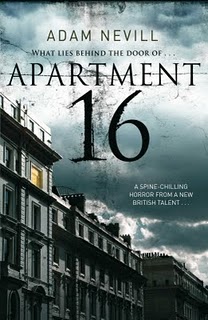
Book Review: Apartment 16 by Adam Nevill

Some books you love.  Some books you hate.  And then, there are some books that you struggle with.  For me, Adam Nevill's Apartment 16, a tale of otherworldly suspense, began as a joy, then became a labour to finish.  And here's why:
 
The story is told from two perspectives; that of Seth, the nightwatchman at Barrington House, and Apryl, the girl just off the plane from America, here in London to claim her late aunt's estate.  The opening is promising, with both narrators providing a compelling account of their experiences in Barrington House - Apryl discovers that her aunt banished all picture frames and mirrors from her walls, while Seth is at first drawn to, and then obsessed by the sounds coming from behind the door of the abandoned Apartment 16.
 
Then events move from the sinister to the more explicitly unnerving.  Seth is approached by a young boy who nobody else can see, who seems to know a lot about Seth's life and the apartment.  Apryl becomes convinced somebody is watching her while she sleeps, and decides to research the history of the building.
 
Without giving too much of the plot away, the second half of the novel is almost unbearably tense as the author slowly reveals layer upon layer of detail.  The former occupant of the apartment was a troubled genius, the building may or may not house an ancient consciousness, and both Apryl and Seth are more constantly plagued by horrific, Lovecraftian visions.
 
Minor Spoilers Ahead!
 
My main problem with this novel (apart from the occasionally clunky dialogue on Apryl's part) is the denouement.  I had begun the story rooting for all of the characters, only to find that one of them has been transformed into a villain.  Also, following the climactic scenes in Apartment 16, I was left with the feeling that nothing had been resolved.  This could well be Adam Nevill's plan, either setting the scene for a sequel or simply leaving the reader with a bleak sense of terror, as good has not triumphed over evil, but merely retreated.
 
This is definitely a book for lovers of the horror genre, with several moments of genuine suspense and mostly excellent prose that never descends into hokum or cliche.  Its city setting, and often depressing depictions of central London as an urban hell, ground the story in reality and make it all the more affecting.
 
I'll give this one 4 out of 5, as I really liked Nevill's writing style, but felt that he made too obvious an effort to get the reader to empathise with Apryl, when Seth was by far the more interesting character.